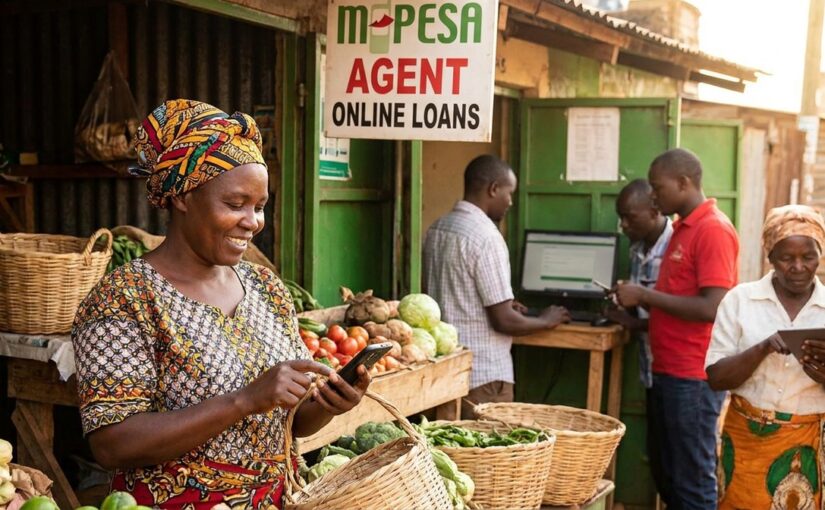
Kenya’s financial inclusion story is often reduced to mobile money, but the economic change is broader. Over less than two decades, millions of people who previously depended heavily on cash have gained easier access to payments, transfers, savings, bank accounts, credit and, increasingly, investment and trading services. This does not mean every financial product reduces poverty or that simply opening an account makes somebody wealthier. The stronger argument is that affordable access to useful financial services gives households more control over money, makes it easier to survive financial shocks and creates better routes for saving or investing income once it has been earned.
The scale of the change is substantial. According to the 2024 FinAccess Household Survey, formal financial access reached 84.8% of Kenyan adults in 2024, while financial exclusion fell to 9.9%. Mobile money remained the main driver, with 82.3% of adults using it, while bank usage reached 52.5%. Those figures show that financial access is no longer confined to people who live close to bank branches, receive formal salaries or can maintain traditional banking relationships.
The effect matters because poverty is not only about how much somebody earns during a good month. It is also about how vulnerable that person is when something goes wrong. An illness, failed harvest, job loss or unexpected school expense can push a household into debt or force it to sell productive assets. Faster payments, accessible savings and the ability to receive money from family members can make those shocks less destructive. Kenya now has some of the strongest research evidence anywhere that better financial access can produce measurable improvements in household welfare.
Financial Inclusion Has Changed What a Bank Account Means
Traditional banking depended heavily on branches. That model works well for customers living in cities, earning regular salaries and making transactions large enough to justify the time and cost involved. It works less well for somebody in a rural area who needs to send KSh1,000 to a relative, receive payment for agricultural produce or keep a modest amount of money somewhere safer than cash at home.
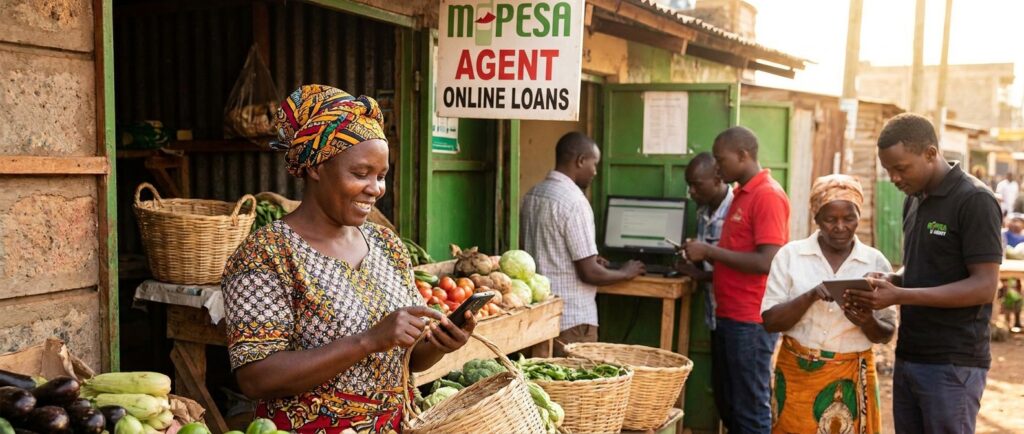
Mobile money changed that calculation. A basic phone and local agent could perform tasks that previously required a journey to a bank. Money could be transferred between family members within minutes, merchants could accept electronic payment and households could keep some financial value digitally rather than entirely in cash. The technology mattered partly because it reduced the minimum useful size of a financial transaction.
Kenya’s current National Financial Inclusion Strategy 2025–2028 takes that development further. The strategy covers payments, savings, credit, insurance, pensions and investment rather than treating inclusion simply as possession of an account. It also recognises an important weakness in the numbers: access has risen strongly while measures of financial health have not improved at the same rate.
That distinction is useful. Financial inclusion should mean that people gain better financial options, not simply that more companies gain the ability to sell them loans or investment products.
There Is Evidence That Financial Access Has Reduced Poverty
Kenya is unusual because researchers have been able to study the long-term economic effects of mobile money rather than relying mainly on surveys asking whether users find it convenient.
A landmark study by economists Tavneet Suri and William Jack examined the spread of M-PESA and estimated that improved mobile money access increased per capita consumption and lifted approximately 194,000 Kenyan households, around 2% of households at the time, out of poverty. Their study, published in Science, also found that the effects were stronger for female-headed households. The researchers linked those gains to greater financial resilience, increased saving and changes in employment, including women moving from agriculture into business and retail activity. The research can be reviewed through the published study on the long-run poverty and gender effects of mobile money.
This finding is more meaningful than simply observing that millions of people use mobile payments. The service changed how households could respond to financial events. Money could be transferred from someone experiencing a relatively good month to a family member dealing with an emergency. Savings could be held and moved more efficiently, while people were less dependent on being physically close to the person providing support.
Mobile money did not create the income being transferred. It made existing household and family resources more useful.
Better Financial Access Makes Households More Resilient
Income instability is one of the less visible features of poverty. A household can earn enough during normal periods but remain one illness or failed harvest away from severe hardship. Financial resilience therefore matters almost as much as average income.
Research on Kenya’s mobile money system has found that households with access were better able to maintain consumption following negative income shocks. World Bank material reviewing the evidence notes that consumption among mobile money users was substantially more resilient when unexpected shocks occurred because transfers could arrive more quickly, from more places and at lower transaction cost. The effect was particularly relevant among lower-income households. World Bank research on mobile money and household resilience discusses that mechanism in detail.
The economic benefit is easy to underestimate because a transfer from a relative does not look like investment or economic growth in the conventional sense. Yet avoiding the forced sale of livestock, business stock or another productive asset can have long-term consequences. A household that survives a temporary shock without destroying its future earning capacity is in a stronger position once normal income returns.
Financial inclusion can therefore reduce poverty in two directions. It can help people improve income, but it can also make it harder for temporary bad luck to push them backwards.
Savings Matter More Than Access to Borrowing
Credit attracts attention because lending can finance a business, agricultural inputs, education or an asset that raises productivity. Savings are less dramatic but can be more important for household stability.
A household with accessible savings can meet an emergency without immediately borrowing. A small shop can replace stock after an unexpected expense rather than closing. A worker with irregular income can move money from a strong month into a weaker one. These are fairly ordinary financial decisions, but they are precisely the decisions that become difficult when every shilling is held in cash and there is no safe, accessible place to keep reserves.
Digital finance has helped connect mobile money with banks, savings products and other formal financial services. The FinAccess survey shows bank usage rising from 40.8% in 2019 to 44.1% in 2021 and 52.5% in 2024, suggesting that mobile finance has not simply replaced conventional banking. It has become one of the routes through which more people can interact with it. The full 2024 FinAccess Household Survey report provides the longer-term usage figures.
The distinction between mobile money and banking has consequently become less important from the customer’s perspective. What matters is whether money can be received, stored, moved and eventually invested at reasonable cost.
Digital Payments Help Small Businesses Operate More Efficiently
Financial access also affects poverty through small businesses. Kenya has a large informal and microenterprise sector where owners often deal with small transactions, irregular cash flow and customers spread across a wide geographical area. Traditional card terminals and full business banking services can be excessive for a trader whose average sale is modest.
Mobile payments allow a shopkeeper, driver, agricultural seller or service provider to receive money electronically without building expensive payment infrastructure. Suppliers can be paid remotely and customers do not need to carry the exact amount of cash. The owner also gains a basic electronic transaction history rather than relying completely on memory and paper records.
These improvements do not guarantee that the business will become profitable. They reduce friction around a business that already has something useful to sell. That difference matters because financial technology sometimes receives credit for creating commercial activity that actually depends on much more basic factors such as demand, skills, transport and product quality.
Still, reducing payment friction can expand the geographical reach of a small business and reduce the amount of working time spent collecting or delivering cash. For a microenterprise, an hour saved can have economic value because the owner and the workforce are often the same person.
Financial services support productivity best when they remove ordinary obstacles rather than attempting to manufacture prosperity through borrowing alone.
Credit Can Create Opportunity and Financial Stress
Easier access to credit is one of the most complicated parts of Kenya’s inclusion story. A loan can finance inventory, agricultural inputs, equipment or education. Those uses can increase future income. The same digital infrastructure can also make it extremely easy to borrow repeatedly for routine household consumption, creating a cycle where each new loan partly exists to manage the previous one.
Kenya has consequently moved to regulate digital lenders more closely. The Central Bank of Kenya reported in July 2026 that 252 digital credit providers had been licensed and that licensed providers had issued 8.37 million loans worth KSh150.56 billion as of May. CBK said the regulatory programme followed concerns about high costs, unethical debt collection and misuse of personal information by previously unregulated providers. The CBK’s July 2026 digital credit licensing update sets out the current position.
This is a good example of why financial inclusion and regulation should not be treated as competing objectives. Easy access to a badly designed financial product can damage a household. The useful form of inclusion combines availability with transparency, reasonable conduct standards and some means of holding providers accountable.
More credit is not automatically more prosperity. Productive credit and expensive dependency are very different things.
Women Have Benefited Disproportionately From Mobile Financial Access
Financial exclusion has historically affected women more heavily because women are more likely to have irregular employment, lower income, fewer assets registered in their names and less control over conventional household banking relationships. Digital finance reduces some of those barriers by allowing money to be received and managed directly through a personal device.
The long-term M-PESA research is especially relevant here. Suri and Jack found stronger poverty effects among female-headed households and evidence that mobile money contributed to women moving from agricultural occupations into business and retail. The change was not simply that women gained another payment method. Greater control over financial resources altered the range of economic choices available to them.
The broader national numbers have moved in the same direction. The 2024 FinAccess survey reported that the gender gap in formal financial access had narrowed to 1.6 percentage points. Mobile money was identified as one of the main drivers of that convergence.
This does not mean equal financial access has produced equal wealth. Income, employment and asset ownership can remain unequal even when men and women can use similar financial infrastructure. Access removes one barrier. It does not remove every economic disadvantage that came before it.
Rural Financial Inclusion Shows Why Technology Matters
A physical branch network is expensive to build across sparsely populated areas. Digital finance changes the economics because one mobile network and a distributed agent network can serve customers whose transactions would never justify a full bank branch nearby.
This has particular value in rural areas where income can be seasonal and distances large. Farmers can receive payments without transporting substantial amounts of cash, relatives working in cities can transfer money home and households can maintain access to savings even when the nearest conventional bank is several hours away.
The remaining excluded population is harder to reach, however. Kenya’s formal financial access rate is already high, which means many people who remain outside the system face structural barriers rather than simply being unaware that financial products exist. Phone affordability, identification, network coverage and digital literacy become more important as inclusion approaches the harder final portion of the population.
The country’s new National Financial Inclusion Strategy recognises this problem and places more emphasis on the quality and impact of financial services rather than counting access alone. It also identifies rural youth and other underserved groups as areas where further work is needed.
Getting from zero to widespread access required technology. Reaching the remaining excluded households will require solving more stubborn social and economic problems.
From Payments to Savings and Investment
The first stage of digital financial inclusion centred on moving money. The next stage increasingly involves helping households store and invest it.
This change is visible in Kenya’s capital markets. The Capital Markets Authority has been licensing new digital intermediaries designed to connect retail investors with regulated investment products. In May 2026, for example, the CMA licensed two Intermediary Service Platform Providers that use digital platforms to connect retail users with regulated collective investment schemes and fund managers. One had previously passed through the CMA regulatory sandbox before receiving its full licence. The CMA announcement on digital access to investment schemes describes the model.
The process continued during 2026 as the CMA authorised additional technology-based intermediaries. These services can reduce the operational barriers between having a small amount of investable money and reaching a regulated fund or securities product.
This is a meaningful progression. A payment account helps somebody transact. A savings product helps them preserve capital. Investment products potentially allow accumulated savings to participate in longer-term economic growth.
Investment inclusion needs considerably stronger financial literacy than basic payments, though. Sending money to a relative is easy to understand. Assessing market risk, fees and expected returns is not.
Trading Services Are Also Becoming Easier to Access
Improved digital infrastructure has made trading easier to access alongside conventional investment. Retail clients can open accounts remotely, follow markets through mobile applications and trade products such as shares, foreign exchange and, through appropriately structured services, CFDs and other derivatives.
Trading should not be presented as a simple poverty reduction programme. Active speculation carries substantial risk, and leveraged trading can destroy savings far faster than conventional investing. A household with no emergency reserve is generally not made more financially secure by gaining access to 100:1 leverage. The development benefit is instead that people who choose to participate in financial markets increasingly have access to formal providers and information rather than being forced toward anonymous overseas platforms.
As Kenya’s retail financial market has grown, better information through sites like forex.ke can help consumers compare products and understand issues such as regulation, leverage and broker structure. Independent information is most useful when it complements rather than replaces official regulator records.
That distinction becomes more important as financial products become complicated. Mobile money can be explained in a sentence. A leveraged forex contract involves margin, spreads, execution, counterparty exposure and the possibility of rapid loss. Wider access needs to be accompanied by enough information for users to recognise those differences before they deposit money.
CMA Regulation Has Changed the Forex Broker Market
Kenya’s retail forex market has become substantially more formal through the development of a dedicated regulatory framework. The Capital Markets Authority regulates online foreign exchange activity and maintains separate licence categories covering non-dealing online forex brokers, dealing brokers and online forex money managers. The CMA’s current regulatory framework includes the Capital Markets (Online Foreign Exchange Trading) Regulations 2017 and the 2023 amendments.
The significance is practical. Kenyan traders can now choose among locally regulated brokers rather than assuming that participation in the global currency market requires sending funds to a company with no meaningful domestic regulatory relationship. The official CMA licence register for non-dealing online forex brokers currently includes multiple locally licensed legal entities associated with international and domestic trading brands.
Regulation does not make forex profitable and should never be described that way. The CMA cannot prevent a trader losing because a currency moves against them or because too much leverage was used. What regulation can do is reduce a different category of risk by imposing licensing requirements, supervising intermediaries and giving consumers a way to distinguish firms that have entered the regulatory system from operators that have not.
That is an important part of responsible financial inclusion. Access to markets is more useful when customers can identify who is legally accountable for the account.
Why the Legal Entity Matters
Broker regulation is easy to misunderstand because trading businesses often operate internationally under one brand while using different companies in different countries. The logo can remain the same while the legal relationship changes completely.
The CMA licence register deals with this problem by naming legal entities and assigning individual licence numbers. Its broader database of approved capital-market institutions also separates brokers, investment banks, fund managers, forex companies and other intermediaries by licence category.
That allows a customer to compare the company named in the account agreement with the company listed by the regulator. Merely recognising the brand is not enough. A global broker might operate one regulated Kenyan company and another offshore company offering higher leverage. An account opened with the latter does not automatically receive the protections attached to the Kenyan entity simply because both businesses share branding.
This may sound technical, but it is one of the most useful financial literacy lessons in online trading. The company that owes the customer money matters more than the colour of the trading platform.
Regulation works best when consumers know how to verify it.
Local Regulation Can Encourage Market Participation
Licensing can look like a restriction because it creates requirements that financial companies have to satisfy before providing certain services. In a market vulnerable to fraud, the same requirements can support growth by giving customers greater confidence that legitimate businesses are distinguishable from anonymous operators.
The CMA is charged with both regulating and developing Kenya’s capital markets. Its responsibilities include licensing intermediaries, supervising licensed firms and promoting investor confidence. The CMA’s description of its statutory role explains that online forex, securities intermediaries and other capital-market participants fall within that remit.
The regulator has also continued adding new market participants. In September 2025, the CMA licensed another non-dealing online forex broker to provide online trading services involving foreign exchange, commodities, equities and CFDs on underlying assets. The CMA announcement on new capital-market licences framed the expansion as part of efforts to broaden Kenya’s capital markets.
The useful economic balance is competition with accountability. More licensed providers can improve choice and pricing. Supervision gives consumers a clearer framework for determining which companies belong in that competitive market.
Better Information Helps Consumers Avoid Financial Scams
As financial access increases, fraud also gets a larger potential audience. A fraudulent investment platform no longer needs an expensive office or a team of salespeople working from Nairobi. It can reach prospective victims through social media, messaging apps or online advertisements and collect funds electronically.
That makes information part of financial infrastructure. Consumers need ways to check whether a broker is actually regulated, understand the significance of the licence and recognise common warning signs before transferring money. Tools that make is easy to avoid scams and find regulated brokers can provide an initial screening layer, while the CMA’s official register remains the authoritative source for verifying Kenyan capital-market licences.
This combination matters because a review site and regulator perform different jobs. A specialist financial site can explain how a product works, compare providers and flag suspicious claims. A regulator confirms whether a legal entity currently holds a licence. Neither role should be confused with the other.
The safest approach is therefore layered. Read independent information, identify the exact company behind the service and then confirm that company directly through the relevant official database.
A convincing website is not regulatory evidence. Neither is an influencer holding a rented sports car.
Scam Prevention Is Part of Poverty Reduction
Fraud can have a disproportionately severe effect on households with modest savings. Losing KSh50,000 does not have the same economic meaning for every person. To one investor it might be an unpleasant portfolio loss. To another household it can represent school fees, several months of rent or the entire working capital of a small business.
Preventing fraud therefore has a welfare effect even though no new income is generated. Money that is not stolen remains available for consumption, education, saving or productive activity.
Online investment scams can be particularly destructive because the platform can display fictional profits that encourage the victim to deposit more. The financial damage sometimes occurs in stages rather than through one obvious theft. A user deposits a small amount, sees apparent returns, sends a larger amount and only discovers the problem after attempting a withdrawal. The fraudster can then request a supposed tax, release fee or further deposit before disappearing.
Better regulation makes this harder by creating an official distinction between licensed and unlicensed providers. Financial education makes it harder again by teaching consumers that high guaranteed returns, pressure to deposit and unexplained withdrawal fees are warning signs rather than premium account features.
Digital finance has reduced many transaction costs. It also reduces the transaction cost of committing fraud, which is why consumer protection needs to develop alongside access.
Financial Access Does Not Automatically Create Financial Health
Kenya’s progress also illustrates an important weakness in the way financial inclusion is sometimes measured. A person can use several financial products and still be financially fragile.
The National Financial Inclusion Strategy reports that formal inclusion rose sharply over the past decade while financial health deteriorated, with its financial-health measure falling to 18.3% in 2024. The strategy explicitly shifts attention from access alone toward usage, quality and impact.
This is an important correction. Someone who has a bank account, mobile wallet, three digital loans and a forex account is very financially included according to a simple access measure. If most income is consumed by debt repayments and there are no emergency savings, that person is not necessarily financially better off.
The same distinction applies at national level. More financial activity can support economic development, but not every transaction creates productive value. Savings invested into a viable business can increase future income. Repeated high-cost borrowing to meet ordinary household expenses may do the opposite.
The aim therefore should not be maximum financial-product usage. It should be better financial outcomes.
Trading Is Access to Opportunity, Not a Guaranteed Income Source
Retail trading deserves a particularly careful place in this discussion because it sits at the intersection of financial inclusion and financial risk.
A mature financial system should allow people with suitable knowledge and capital to access markets. Preventing ordinary citizens from investing or trading while reserving financial markets for institutions and wealthy investors would hardly represent inclusion. At the same time, presenting speculative trading as a straightforward escape from poverty would be irresponsible.
Forex and CFD trading use leverage, and losses can accumulate quickly when positions are too large. The presence of a CMA licence means that the broker has entered the local regulatory framework. It does not mean the regulator has approved a customer’s trading strategy or guaranteed the account against market losses.
The developmental benefit therefore comes from creating legitimate access and reducing avoidable intermediary risk. Consumers who decide to trade can use domestic regulation rather than dealing exclusively with anonymous overseas firms. They can compare licensed providers, verify legal entities and find educational material before funding an account.
That is better access. It is not free money.
A healthy financial system needs to be capable of explaining the difference.
Better Regulation Can Make Innovation More Sustainable
Financial technology develops faster when customers believe the infrastructure can be trusted. Regulation therefore has an economic role beyond punishing bad actors after something has gone wrong.
The CMA has used its regulatory sandbox and newer intermediary categories to allow financial technology companies to test investment services under supervision before expanding them to wider groups of customers. The 2026 licensing of digital investment platforms shows how regulation can support new distribution models rather than simply preserve conventional ones.
The same principle applies to digital credit. CBK did not ban online lending when consumer problems emerged. It created a licensing framework intended to bring providers into a clearer regulatory structure.
That approach is important for Kenya because digital finance has become too economically important to treat innovation and regulation as opposites. Weak supervision can allow scams and abusive practices to damage public confidence. Excessive restrictions can prevent useful services reaching customers who traditional finance serves poorly.
The more productive middle ground is regulated experimentation. New services can enter the market, but companies need identifiable legal entities, clear responsibilities and rules governing how customers are treated.
Innovation is easier to sustain when the customer does not have to assume every new financial app is guilty until proven innocent.
Better Access Is Moving Kenya From Transactions Toward Asset Building
The most interesting part of Kenya’s financial inclusion story may now be what happens after basic access has largely been achieved.
Mobile payments solved a practical problem: how to move relatively small amounts of money quickly and cheaply. Wider banking access improved the ability to store and manage money. Digital credit added financing, although with some well-documented risks. The current expansion of digital investment services begins addressing another question: how can households with savings convert those savings into productive financial assets?
This progression matters because long-term poverty reduction requires asset building as well as consumption. Income that is entirely spent leaves little protection against future shocks. Savings provide resilience, while productive investments can generate returns and help households accumulate wealth over time.
Kenya’s capital-market participation remains much smaller than its mobile-money participation, so there is plenty of room between having a wallet and becoming an investor. The regulatory and educational requirements also become tougher as products become more complex.
That makes the next stage less spectacular than the mobile-money boom. It requires gradual improvement in savings behaviour, financial literacy, investment access and consumer protection rather than one technology suddenly reaching most of the population.
Financial progress gets slower as the problems become harder.
Financial Services Are One Part of the Poverty Equation
Finance cannot substitute for economic growth, good jobs, education, infrastructure or productive businesses. A person cannot save income that does not exist, and cheaper payments do not help much when a household has no money to send.
Financial services are better understood as economic infrastructure. They determine how efficiently people can use the resources they already have and how easily they can connect those resources with opportunities elsewhere.
For a small business, that might mean receiving customer payments remotely and financing inventory. For a worker, it can mean saving part of a salary safely. For a rural household, it may mean receiving emergency money from relatives. For somebody with accumulated savings, it can eventually mean accessing regulated investment products. For an experienced trader, it can mean entering markets through a locally supervised intermediary rather than an unknown offshore company.
Those services operate at different levels of financial sophistication, but the common thread is access to a formal system that makes money easier to move, store and allocate.
The poverty impact comes when that infrastructure helps households preserve or increase productive capacity.
Kenya’s Next Step Is Better Financial Outcomes
Kenya has already achieved something substantial. Formal financial access has moved from being the preserve of a relatively small section of the population to reaching more than four-fifths of adults. Research provides credible evidence that the expansion of mobile money contributed to lower poverty, greater household resilience and better economic opportunities for women.
The next phase needs a harder standard. Success cannot be measured only by the number of people with accounts, loans or trading apps. It needs to be measured by whether households can save, withstand emergencies, avoid predatory debt, invest productively and recognise fraudulent services before money changes hands.
That is where regulation and information become as important as technology. CBK supervision of lenders, CMA regulation of investment and trading firms, digital access to regulated products and independent information all help make the financial system easier to use without pretending risk has disappeared.
Kenya’s strongest lesson is therefore not simply that technology can bring finance to millions of people. It is that useful financial access can change how households respond to risk and opportunity. When access is combined with sensible regulation, credible information and products that serve genuine economic needs, financial services become more than a convenient way to move money.
They become part of the infrastructure that makes it easier for people to build and keep wealth.