Foreign exchange markets affect almost every open economy, but the effect can be unusually visible in developing countries. A currency movement that barely registers in a highly diversified advanced economy can change the cost of fuel, machinery, medicine, debt repayments and basic food imports in a lower-income country within months. Governments need foreign currency to service external debt, importers need it to pay suppliers, exporters earn it from overseas customers, migrants send it home as remittances and central banks hold it as reserves. Retail forex trading is only a small part of this much larger system.
This distinction matters because “forex trading” often brings to mind an individual buying EUR/USD or GBP/USD through an online broker. At national level, foreign exchange is more fundamental. It determines how easily domestic money can be converted into dollars, euros, pounds, yen or other currencies required for international transactions. Exchange rates affect inflation, government finances, company balance sheets, capital flows and the purchasing power of households.
Developing economies can be especially sensitive because imported essentials often represent a meaningful share of consumption, international borrowing can be denominated in foreign currencies and domestic financial markets may provide fewer ways to hedge currency risk. The IMF has noted that exchange-rate movements generally have a larger effect on inflation and financial stability in emerging markets than in advanced economies. In a 2025 assessment, it estimated that a 10% depreciation against the dollar raises emerging-market price levels by roughly 2% on average, although effects differ substantially between countries. The IMF’s analysis of monetary policy in emerging markets explains why currency stability often receives so much attention from policymakers.
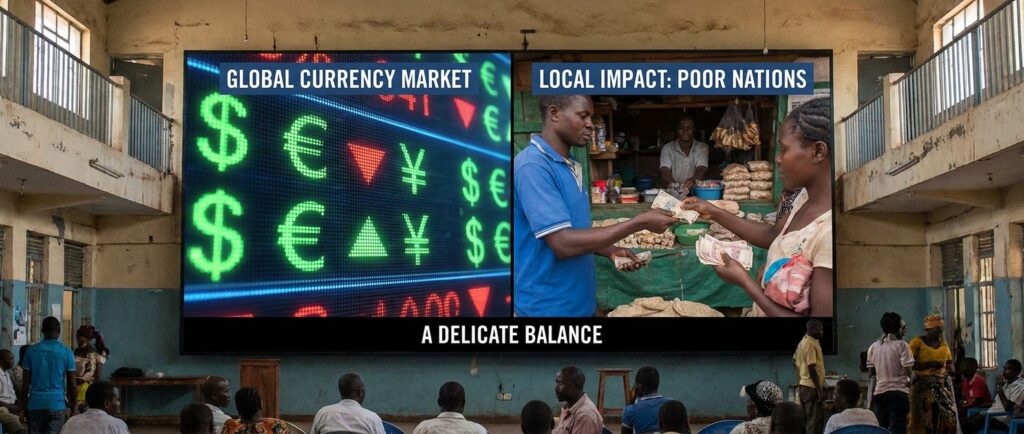
The Forex Market Is Much Bigger Than Retail Currency Trading
Foreign exchange exists because international trade and finance require currencies to be exchanged continuously. A manufacturer importing machinery must obtain the supplier’s currency. An exporter receiving dollars may convert them into local money to pay employees. A pension fund buying foreign assets needs overseas currency, while a company with dollar debt may buy dollars before an interest payment becomes due.
These transactions operate alongside speculative trading by banks, hedge funds and individual traders. The Bank for International Settlements found that emerging-market currencies accounted for approximately 29% of global foreign-exchange turnover in April 2025, with about $2.8 trillion traded per day across OTC and exchange markets. Much of that growth came from larger economies such as China and India, but the broader trend is important: emerging-market currencies increasingly form part of global trading and investment flows. The BIS review of emerging-market currency trading shows how their share has risen from below 10% in the early 2000s.
Developing economies are not identical to the emerging markets used in BIS and IMF datasets. Some are much smaller, poorer or less integrated into global capital markets. The economic mechanisms are nevertheless similar. Foreign currency has to enter through exports, tourism, remittances, investment, borrowing or reserve sales before it can finance imports, overseas investment and external debt payments.
The health of that market therefore affects much more than traders looking at candlestick charts.
Currency Depreciation Makes Imports More Expensive
One of the fastest ways the forex market reaches ordinary households is through import prices. If a country imports fuel at a dollar price but its domestic currency falls sharply against the dollar, the same barrel of oil becomes more expensive in local money even when the international oil price has not changed.
Consider an imported product costing $1,000. At an exchange rate of 100 units of local currency per dollar, the importer pays 100,000 before shipping and taxes. If the local currency weakens to 120 per dollar, the same $1,000 invoice now costs 120,000. Nothing about the physical product has changed. The currency movement alone increased its local cost by 20%.
That effect spreads through the economy when imported products are used as inputs. More expensive fuel raises transport costs. More expensive imported fertiliser raises agricultural expenses. Imported machinery becomes harder for businesses to finance, while foreign pharmaceutical products can put pressure on healthcare budgets. Companies may absorb part of the increase temporarily, but sustained depreciation usually forces some adjustment through higher prices, lower margins or reduced imports.
Exchange-rate pass-through tends to be stronger in many emerging economies than in advanced markets, partly because imports are important and inflation expectations may be less firmly anchored. The IMF notes that depreciation can therefore leave central banks facing an uncomfortable choice between supporting economic activity and raising interest rates to limit inflation.
Currency Weakness Can Feed Domestic Inflation
The inflation effect goes beyond products bought directly from abroad. A bakery may purchase local flour but use imported fuel, equipment or packaging. A bus company buys labour locally but pays for fuel linked to international energy prices. A construction company can employ domestic workers while relying on imported machinery and materials.
Exchange-rate movements therefore appear indirectly in prices that consumers may think of as entirely domestic.
The size of this effect depends on economic structure and policy credibility. Countries with stable inflation expectations, credible central banks and competitive domestic markets can sometimes absorb currency movements more smoothly. Others experience faster pass-through because businesses expect future depreciation and raise prices pre-emptively, workers seek higher wages and importers have little ability to switch to domestic alternatives.
This helps explain why central banks in developing economies can appear unusually concerned with the exchange rate even when they officially operate inflation-targeting regimes. A sharp currency fall is not simply a number displayed on a forex screen. It can affect inflation, consumer confidence and expectations about future prices.
The relationship works in the opposite direction too. Currency appreciation can reduce the domestic cost of imported goods and ease inflationary pressure. That sounds universally positive, but sustained appreciation can create problems for exporters and domestic companies competing against cheaper imports.
The forex market continuously redistributes advantages between different parts of the economy.
A Weaker Currency Can Help Exporters, but the Story Is Not Simple
Basic economics suggests that currency depreciation makes a country’s exports cheaper for foreign buyers. If a company sells products priced mainly in local currency, overseas customers can purchase those goods using fewer dollars after the domestic currency weakens. This can improve export competitiveness and increase demand.
That channel is real, but developing economies often face complications. Exporters themselves may rely heavily on imported machinery, fertiliser, fuel, chemicals or components. A weaker currency can therefore lower the foreign price of their final product while increasing the local cost of producing it.
Dollar invoicing creates another issue. International trade is frequently priced in US dollars even when neither the buyer nor seller is American. This means the immediate trade benefit from a weaker local currency can be less straightforward than the textbook example suggests.
The financial effect can overwhelm the trade effect completely when companies owe substantial foreign-currency debt. An exporter might gain from improved competitiveness while simultaneously seeing the local-currency value of its dollar liabilities increase.
BIS research on the US dollar has found that dollar appreciation can actually weaken export growth in emerging markets rather than reliably stimulating it through cheaper currencies. Stronger dollar conditions tend to tighten global credit and reduce investment, particularly in economies exposed to dollar debt and international capital flows. The BIS analysis of the dollar as an emerging-market risk factor illustrates why the financial channel can overpower the simple export-competitiveness story.
The US Dollar Has an Outsized Role
The dollar matters because it is not just another currency pair. It is widely used for trade invoicing, commodity pricing, international borrowing, reserves and cross-border finance. Developing economies can therefore be affected by a broad rise in the dollar even when they conduct relatively little direct trade with the United States.
IMF research examining a major period of dollar strength found that a 10% dollar appreciation driven by global financial forces was associated with a 1.9% decline in output in emerging-market economies after one year. The effects lasted for roughly two and a half years. Imports fell sharply, capital inflows weakened and financial conditions tightened. The IMF analysis of strong-dollar effects on emerging economies found the damage substantially greater than in smaller advanced economies.
A strong dollar can affect several parts of a developing economy simultaneously. Governments and companies need more local currency to service dollar debt. Imports priced in dollars become more expensive. Foreign investors can become less willing to hold riskier local assets, while domestic central banks may hesitate to reduce interest rates because lower rates could put additional pressure on the currency.
This is why monetary policy decisions by the US Federal Reserve can matter in economies thousands of kilometres away. Higher US interest rates can make dollar assets more attractive, alter capital flows and increase the financing cost faced by borrowers around the globe.
A local central bank controls its own policy rate. It does not control the price of dollars.
Capital Flows Can Move Currencies Quickly
Foreign investment can provide developing economies with capital that domestic savings alone would struggle to supply. Foreign direct investment can finance factories, telecommunications networks, mines and other productive assets. Portfolio investors can purchase government bonds and equities, providing additional funding and market liquidity.
The forex market is part of this process because foreign investors normally need to acquire the domestic currency before buying local assets. Large inflows can therefore support the exchange rate, while rapid withdrawals can place pressure on it.
Portfolio money can be particularly sensitive because it can leave much faster than physical investment. A factory cannot be moved out of a country on Tuesday afternoon because bond yields changed. A foreign investor can sell government securities and convert the proceeds back into dollars very quickly.
When global investors become more risk averse, developing economies can therefore experience a combination of capital outflows, currency depreciation and higher borrowing costs. Domestic central banks then face a difficult decision. Raising interest rates may support the currency and reduce inflation pressure, but tighter money can slow credit and domestic growth.
BIS research published in 2026 found that emerging economies with high foreign-currency debt and relatively shallow FX markets tend to respond more strongly to US monetary shocks. They also rely more heavily on foreign-exchange intervention when markets are thin. The BIS research on external shocks and FX-market depth shows why deeper financial markets can give policymakers greater freedom.
Foreign Currency Debt Can Turn Depreciation Into a Balance-Sheet Problem
Borrowing in dollars can appear attractive when dollar interest rates are lower than domestic borrowing costs or when international lenders are unwilling to lend large amounts in the local currency. Governments and companies then accept currency risk in exchange for access to cheaper or larger pools of capital.
The problem appears when the local currency falls.
Imagine a company owes $10 million. At 100 local currency units to the dollar, the liability is worth one billion in domestic money. If the exchange rate moves to 150, the same dollar debt becomes worth 1.5 billion locally even though the company borrowed no additional money.
If its revenues are mainly domestic, the company’s debt burden has increased while its underlying business may be producing roughly the same local-currency cash flow. This can reduce investment, damage bank balance sheets and, in extreme cases, contribute to corporate defaults.
The same problem affects governments. A country collecting tax revenue in domestic currency but servicing dollar bonds can see its debt-service burden jump after depreciation. BIS statistics emphasise that countries borrowing in major foreign currencies face currency risk on top of the ordinary interest cost of debt. The BIS review of foreign-currency debt in emerging markets explains how exchange-rate valuation changes can alter external balance sheets sharply.
This is one reason developing local-currency bond markets matters. It moves more of the exchange-rate risk away from domestic borrowers.
Deeper Local Markets Can Reduce Currency Vulnerability
Many emerging economies have spent years developing domestic bond markets precisely because reliance on foreign-currency borrowing makes macroeconomic management harder.
If a government can sell long-term bonds in its own currency, depreciation no longer increases the nominal local-currency value of that debt. The currency risk may instead sit with the foreign investor holding the bond. That is an improvement for the sovereign borrower, although it does not make the economy immune to external shocks.
Foreign investors can still sell local-currency bonds when risk appetite changes, driving the currency down and bond yields up simultaneously. The 2025 BIS Annual Economic Report notes that the exchange-rate risk in many emerging markets has gradually shifted from borrowers to foreign investors as local-currency bond markets have developed. Currency movements can consequently influence whether those investors continue supplying capital.
This is one reason deeper forex and derivatives markets are valuable. Businesses and investors can hedge exposures rather than treating every currency movement as an unavoidable balance-sheet shock.
Financial-market development therefore has a macroeconomic purpose beyond creating more products for traders. A functioning FX market can help companies manage genuine commercial risk and improve the economy’s ability to absorb international shocks.
Central Banks Use Foreign Exchange Reserves as a Buffer
Developing countries commonly hold reserves of dollars, euros, gold and other internationally accepted assets. These reserves can be used to pay for essential imports, meet external obligations and intervene when currency markets become severely disrupted.
If a currency is falling rapidly because everyone wants dollars at once, the central bank can sell some of its dollar reserves and buy domestic currency. This increases foreign-currency supply and can reduce disorderly market conditions.
Intervention is not free. Reserves are finite and expensive to accumulate. A central bank that repeatedly sells dollars to defend an unrealistic exchange rate can eventually run dangerously low, leaving the economy with fewer resources to finance imports or respond to a genuine emergency.
The IMF’s framework for foreign-exchange intervention argues that intervention can be useful when FX markets become illiquid, unhedged foreign-currency exposures threaten financial stability or sharp depreciation risks destabilising inflation expectations. It also warns that intervention should not replace necessary economic adjustment.
A credible reserve position can itself influence behaviour because investors know the central bank has some capacity to manage disorderly conditions. The challenge is using that capacity without pretending the currency can be permanently held at a price the underlying economy does not support.
Forex Shortages Can Disrupt the Real Economy
The most visible foreign-exchange problem in some developing economies is not excessive trading but the inability to obtain enough foreign currency through official channels.
An importer may have sufficient local money to buy machinery but still be unable to find the dollars needed to pay the supplier. Businesses then wait for banks to allocate scarce currency, postpone orders or turn to parallel markets where dollars trade at a substantial premium.
These shortages can reduce production. If a factory cannot import replacement components, domestic employment can be affected even though the initial problem appeared in the foreign-exchange market. Shortages of foreign currency can also restrict imports of fuel, medicine and fertiliser, creating political as well as economic pressure.
Ethiopia provides a recent example. IMF analysis found that before its July 2024 foreign-exchange reform, acute FX shortages coincided with a parallel-market premium exceeding 100%. Reserves had fallen below one month of import coverage during much of the period from late 2021 to mid-2024, and official FX supply became concentrated on essentials such as fuel, fertiliser and medicine. Following the move toward a market-determined exchange rate, the official and parallel rates initially converged sharply and foreign-exchange availability improved. The IMF’s 2025 analysis of Ethiopia’s FX reforms documents both the improvement and the remaining problems.
That example shows why the forex market is not an abstract financial arena. When it stops functioning efficiently, ordinary trade can stop functioning efficiently too.
Parallel Forex Markets Are Usually a Symptom
A parallel market develops when the official exchange rate or access rules do not clear the actual supply and demand for foreign currency.
Suppose the official rate is 100 local units per dollar, but banks cannot supply all the dollars businesses and households want at that price. An informal seller willing to provide dollars immediately may charge 130 or 150 instead. The difference between the official and parallel rates becomes a measure of the imbalance.
Large gaps create distortions. Exporters can have an incentive to keep foreign earnings abroad or divert them toward unofficial channels. Importers receiving scarce official dollars gain an implicit subsidy compared with firms forced to use the parallel market. Businesses can struggle to determine which exchange rate reflects their real costs.
In severe cases, a multiple-rate system also encourages corruption because access to cheap official foreign currency has substantial economic value.
Moving toward a market-clearing exchange rate can reduce these distortions, but adjustment can be painful. The official currency may depreciate sharply, immediately raising some import prices and foreign debt burdens.
The choice is therefore rarely between a painful reform and a painless status quo. A prolonged FX shortage already imposes costs through unavailable imports, weaker investment and distorted allocation.
The forex market eventually clears somewhere. The question is whether that occurs transparently in the formal financial system or at a premium in the street and informal networks.
Remittances Supply Vital Foreign Currency
Remittances are another important connection between foreign exchange and developing economies. Migrant workers earn income abroad and send part of it home, creating a steady source of foreign currency for recipient countries.
The World Bank estimated that officially recorded remittances to low and middle-income countries reached about $656 billion in 2023 and were expected to rise to around $685 billion in 2024. That would make remittances larger than foreign direct investment and official development assistance combined. The World Bank’s remittance estimates underline how important these flows have become to external financing.
For some smaller countries the effect is enormous. World Bank estimates placed remittances at roughly 45% of GDP in Tajikistan and 27% in Nicaragua during 2024, illustrating how overseas earnings can become one of the largest sources of foreign currency in an economy.
Remittance inflows can strengthen household consumption, improve the current account and increase the supply of foreign currency. They can also influence the exchange rate itself. An IMF study of remittances and real exchange rates notes that large inflows may contribute to appreciation in some economies, although the strength of this relationship varies according to exchange-rate regime and economic structure.
Foreign exchange can therefore enter a developing economy one household transfer at a time.
Commodity Exporters Face Another Type of Forex Risk
Developing economies dependent on commodities can experience large foreign-exchange swings because export earnings are tied closely to world prices.
An oil exporter earns far more dollars when crude prices are high. That improves the supply of foreign currency, supports government revenue and can strengthen the local exchange rate. When oil prices fall, export receipts decline and the same economy can suddenly face pressure on reserves, public finances and the currency.
The pattern applies to countries dependent on metals, coffee, cocoa or other commodities. The exact product differs, but concentrated export structures make the supply of foreign currency vulnerable to one international price.
Currency appreciation during a commodity boom can create its own problems. Non-commodity exporters become less competitive and imports become cheaper, potentially leaving the economy more dependent on the dominant sector. When the boom ends, the exchange rate then has to adjust while other export industries remain underdeveloped.
This is why exchange-rate management cannot compensate permanently for a narrow economic base. Holding the currency stable may reduce volatility temporarily, but it does not remove the underlying dependence on foreign earnings from one product.
Economic diversification is therefore also a form of forex risk management.
A country with several competitive export sectors has several ways of earning the foreign currency needed to finance imports and external obligations.
Businesses Need Forex Markets for Hedging, Not Just Speculation
A deeper foreign-exchange market can help developing economies because companies often need to manage genuine commercial risks.
Consider an importer that agrees today to pay $1 million for machinery in six months. If its local currency falls 15% before payment, the machine becomes 15% more expensive in domestic money. The company can leave that exposure open and hope the exchange rate remains favourable, or it can potentially use a forward or another hedging instrument to lock in a rate.
Exporters face the opposite problem. A company expecting $1 million from overseas customers several months from now can suffer if its domestic currency strengthens before the dollars are converted.
Developed FX derivatives markets allow these firms to transfer some exchange-rate uncertainty to financial institutions and investors willing to carry it. In shallow markets, hedging can be expensive or unavailable, forcing businesses to carry currency risk directly on their balance sheets.
Recent BIS research notes that shallow FX markets and high hedging costs make external shocks harder for emerging economies to manage. Countries with deeper markets and broader access to hedging instruments tend to have more room for monetary policy and less need to respond aggressively to every external currency shock.
This is one of the clearest positive contributions of forex-market development. Speculation receives more attention, but hedging is often more important to the real economy.
Retail Forex Trading Is a Small Part of the Economic Story
Retail forex trading has expanded as internet access, electronic payments and smartphone use have made brokerage accounts available across developing economies. Traders can now speculate on major currency pairs without needing a traditional dealing room or a large institutional account.
That increased access can support financial-sector development, encourage competition among brokers and create demand for better financial education. Traders researching international account structures and providers can use general comparison resources such as ForexBrokersOnline.com alongside the official register maintained by the regulator responsible for their jurisdiction.
Retail trading should not, however, be confused with the foreign-exchange activity that drives national economic outcomes. A country’s currency does not normally strengthen because a few thousand retail traders bought it through leveraged broker accounts. Commercial trade, institutional investment, government borrowing, remittances, central-bank policy and global capital flows operate at far larger scales.
There is also no reason to assume that expanding speculative trading automatically benefits a developing economy. Highly leveraged retail products can generate household losses, particularly where regulation and financial literacy are weak. The useful economic contribution comes from legitimate financial-market development, competition and access to risk-management services rather than simply maximising the number of people placing speculative currency trades.
A deeper market and more retail speculation are not the same thing.
Forex Brokers Can Still Affect Financial Development
Although retail trading volumes are relatively small in macroeconomic terms, the quality of the brokerage sector can still matter.
Properly regulated brokers give customers access to financial markets through legal entities subject to local or recognised overseas rules. They can also create demand for payment infrastructure, market data, financial education and skilled employment. In countries developing domestic capital markets, regulated online trading can form part of a broader move toward formal financial services.
Weakly supervised brokerage markets can produce the opposite result. Scams, withdrawal disputes and excessive leverage can destroy household savings and damage trust in the wider financial system. Money sent to fraudulent overseas operations also leaves the domestic economy without producing a useful financial service in return.
This is why regulation needs to distinguish market risk from intermediary risk. A regulator cannot prevent a trader from losing money because EUR/USD moved against them. It can require brokers to meet capital and conduct standards, disclose risks and avoid misleading claims.
The economic objective should not be to guarantee trading profits. That is impossible. It should be to ensure that people taking market risk are not unknowingly taking avoidable fraud and counterparty risk at the same time.
That principle applies as much in developing financial markets as it does in London, New York or Singapore.
Exchange-Rate Flexibility Can Help Economies Absorb Shocks
Allowing a currency to move can be politically uncomfortable because depreciation is visible and can quickly raise import costs. A flexible exchange rate nevertheless performs an economic function by changing relative prices when external conditions change.
If export earnings fall sharply, a weaker currency can reduce import demand and eventually support domestic production or exports. Trying to maintain the old exchange rate despite a permanent deterioration can instead require large reserve sales, higher interest rates or restrictions on access to foreign currency.
Modern IMF policy does not argue that every developing economy should simply ignore disorderly currency moves. Its Integrated Policy Framework recognises situations where intervention can be useful, particularly when markets become illiquid or balance-sheet vulnerabilities threaten financial stability. The principle is that intervention should address market dysfunction rather than attempt indefinitely to prevent adjustment to economic fundamentals.
Countries have also become better at operating flexible regimes. The IMF noted in 2025 that many emerging economies now have stronger central banks, better-anchored inflation expectations and more developed local-currency debt markets than in earlier periods of global stress. Those institutional improvements have allowed currencies to absorb more shocks without automatically triggering the kind of economic crises seen in previous decades.
A floating currency is not evidence that policymakers have lost control. Sometimes allowing the price to change is part of maintaining control.
Currency Stability Is Useful, but an Artificial Rate Can Be Expensive
Businesses prefer predictable exchange rates because uncertainty makes planning difficult. An importer deciding whether to build a factory wants some confidence about future equipment costs, while a foreign investor needs to know that profits can eventually be converted and repatriated.
That does not mean the most stable possible exchange rate is always the best one.
A government can maintain an artificially strong currency temporarily by selling reserves or restricting access to foreign exchange. If the official rate no longer reflects supply and demand, shortages and parallel markets can emerge. Imports are then allocated through administrative decisions rather than price, while exporters can receive fewer local currency units for every dollar earned than the true market value.
The result can undermine the activity the stable exchange rate was supposed to support.
A credible and reasonably liquid forex market often matters more than achieving one particular number. Businesses need to know that currency can be obtained, prices reflect actual conditions and hedging is possible when exposures become large.
Ethiopia’s recent reform illustrates the trade-off. Moving toward a market-determined exchange rate caused a substantial adjustment in the official currency price, but the IMF subsequently reported greater FX availability and a large reduction in the gap between official and parallel rates compared with the pre-reform period.
A cheap official dollar that nobody can actually buy has rather less economic value than the quoted rate suggests.
Forex Markets Can Support Development When They Work Properly
A functioning foreign-exchange market helps connect a domestic economy with the rest of the financial system. Exporters can convert overseas earnings, importers can obtain currency to pay suppliers, remittances can enter through formal channels and investors can move capital without relying entirely on informal markets.
Deeper markets can also improve price discovery. If banks, companies and investors are able to buy and sell currency freely within a regulated framework, the exchange rate contains more information about actual demand and supply. That makes it easier for businesses and policymakers to distinguish temporary volatility from a persistent shortage.
Hedging markets add another benefit by allowing companies to reduce uncertainty around future foreign-currency payments. This can support investment because firms do not need to leave every overseas transaction exposed to whatever happens to the exchange rate before settlement.
The benefits depend on institutions. Transparent rules, credible monetary policy, adequate reserves, functioning banks and effective financial supervision all determine whether currency markets contribute to economic development or become another source of instability.
Forex is therefore neither inherently good nor bad for developing countries. It is financial infrastructure. Its economic effect depends on how heavily the country relies on foreign currency, how efficiently the market distributes it and whether businesses can manage the risks attached to it.
Why Forex Matters So Much to Developing Economies
Foreign exchange markets can affect a developing economy more directly than many people realise because currencies connect domestic economic activity with almost everything happening outside the country.
A weaker currency can raise inflation by increasing import prices, make foreign debt harder to service and discourage investment when balance sheets are heavily exposed to dollars. It can also improve some exporters’ competitiveness and help an economy adjust to external shocks. Large remittance inflows provide foreign currency and household income, while commodity exports, tourism and foreign investment determine how much additional FX enters the country.
Central banks use reserves and interest rates to manage these pressures, but their room for manoeuvre depends on the depth of financial markets, the credibility of economic policy and the extent of foreign-currency borrowing. When formal markets fail to clear supply and demand, shortages and parallel exchange rates can emerge, affecting real businesses long before most households think of the problem as “forex.”
Retail currency trading sits at the outer edge of this much larger system. It can broaden participation in financial markets and encourage a more developed brokerage sector, but its macroeconomic importance is modest compared with trade, debt, investment and remittance flows.
For developing economies, the most valuable forex market is therefore not necessarily the one with the most speculative trading. It is one where importers can obtain currency, exporters can convert earnings, businesses can hedge risk, investors trust the rules and the exchange rate can adjust without turning every external shock into a domestic crisis.